
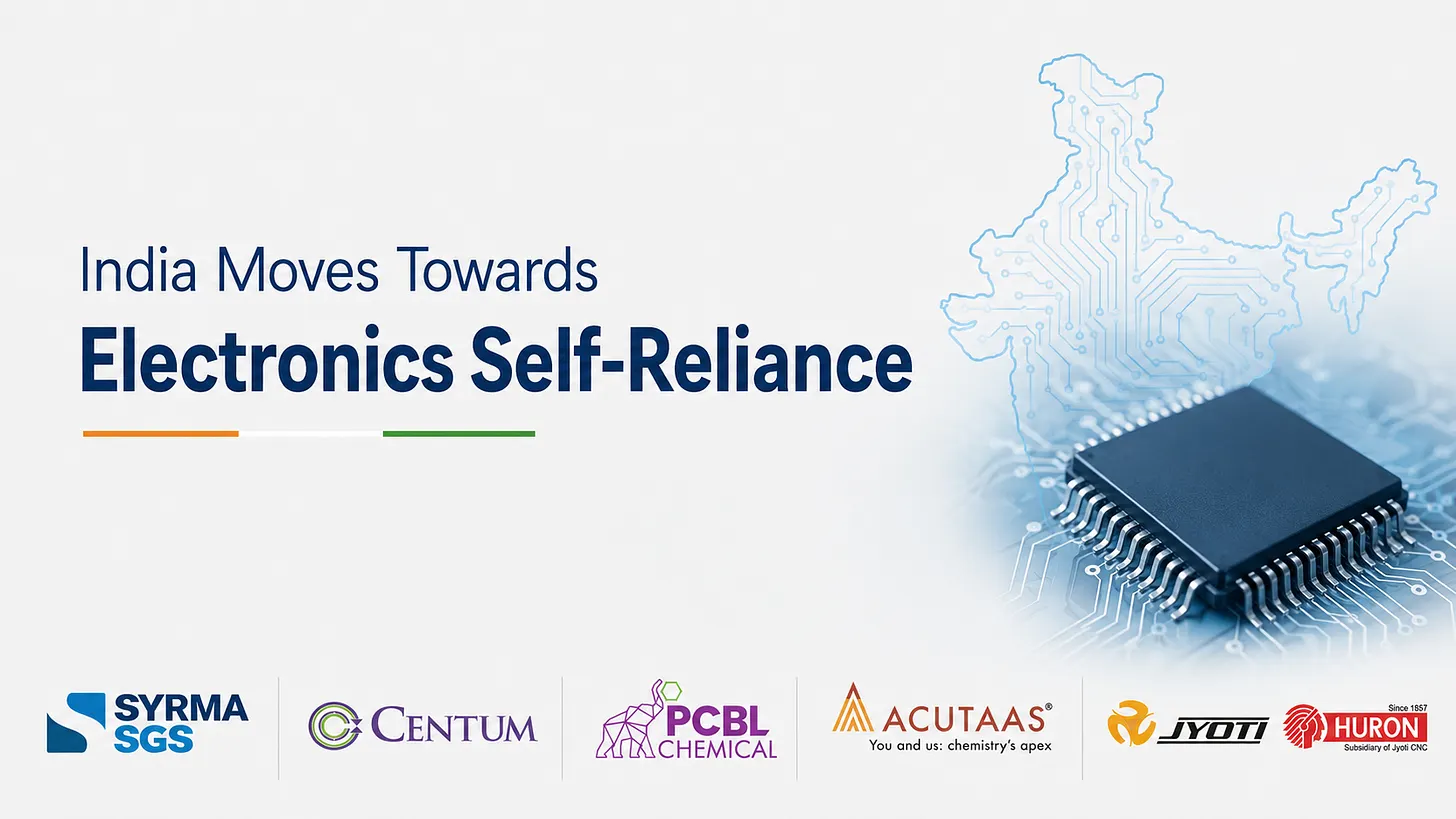
India has spent the last few years becoming a serious electronics manufacturing hub.
But there has always been a catch. We were getting very good at assembling electronics without necessarily making all the important parts that go inside them.
That is now starting to change. On Monday, the government approved another 31 new projects under the Electronics Components Manufacturing Scheme, or ECMS.
The headline numbers are big: 106 projects, ₹69,548 crore of approved investment and nearly 75,000 direct jobs.
But the bigger story isn’t the investment. It is what these companies are actually going to manufacture.
From assembling phones to making what goes inside them:
Think about a smartphone. India can assemble the phone here. But the camera module, connectors, filters, capacitors, display components, and several specialised materials could still come from somewhere else.
That means a large part of the economic value sits outside India. This is exactly the gap ECMS is trying to address.
The latest approvals cover 20 different product categories, ranging from camera and display modules to connectors, relays, capacitors, antennas and coils.
More importantly, some of the approvals are for materials that sit even further upstream.
For example, India will now have domestic manufacturing of anode material, acetylene black and electrolyte additives, all important inputs for batteries and electronics.
There are also projects for rare-earth permanent magnets and metallised films used in capacitors.
So this isn’t simply about making another factory that assembles a finished product.
The government is trying to build the supply chain underneath the factory.
And that’s a much more important shift.
The interesting part: some capacities can already meet domestic demand
Here’s where this gets interesting.
According to the government, the capacities being created under ECMS are already enough to meet domestic demand in several categories.
For some products, capacity could actually exceed India’s current requirements.
Anode material capacity, for instance, is expected to reach around 110% of domestic demand.
Optical transceiver-SFP capacity could reach around 350%, while relay capacity could reach about 200%.
At first glance, this might sound like overcapacity. But there is another way to look at it.
India doesn’t just want to replace imports. It wants to become an exporter.
That’s the playbook we have already seen in mobile phones.
India started by assembling phones for the domestic market. As the ecosystem improved, production expanded, and exports followed. The same thing could happen further down the value chain.
There are already signs that this is working:
This isn’t entirely a future story anymore.
Of the 106 projects approved under ECMS, 38 plants have already started manufacturing, while another 16 are in advanced stages of construction or machinery installation.
And the broader electronics manufacturing industry has already become significantly larger.
Government data shows India’s electronics production has risen to more than ₹13 lakh crore, while electronics exports have crossed ₹4 lakh crore. The sector now supports roughly 25 lakh jobs.
So the base has already been created. ECMS is essentially trying to deepen it.
The companies worth watching:
This is where the story becomes interesting from an investing perspective. The latest list includes names across several parts of the electronics and industrial ecosystem.
Syrma SGS is getting approval for coils.
Centum Electronics gets projects for transducers and filters.
PCBL Chemical will manufacture acetylene black, a conductive additive used in lithium-ion batteries.
Acutaas Chemicals gets approval for electrolyte additives.
Jyoti CNC Automation is among the companies approved for capital goods.
There are also global players such as Amphenol, Mitsubishi Electric, and Sensata participating in the ecosystem. And that matters because these aren’t companies operating in isolation.
They are potentially becoming part of a much larger manufacturing chain. The interesting investment question, therefore, isn’t simply: “Who gets the government incentive?” It is: “Who becomes an important supplier to India’s next generation of electronics manufacturing?”
That’s a very different way of looking at the theme.
But there is one thing investors should be careful about:
Government incentives can help build capacity. They cannot automatically create a competitive business. We’ve seen this before. A factory can be built. Machines can be installed. Production can begin. But eventually, the product still has to compete on cost, quality, reliability, and scale.
This is particularly important because electronics supply chains are brutally competitive. China, Taiwan, Vietnam, South Korea, and other manufacturing hubs already have mature ecosystems.
So India’s first milestone isn’t becoming the cheapest manufacturer overnight. It is getting good enough that global companies are willing to make India part of their supply chain. Once that happens, scale can follow.
Our Takeaway:
There is a broader pattern emerging across India’s industrial policy. The country first wanted to manufacture the finished product. Then it started pushing for components.
Now the focus is moving towards materials, machinery and specialised manufacturing capabilities.
The same logic is visible in semiconductors, batteries, defence, solar and other strategic industries.
Subsidies can help create the initial capacity, but subsidies alone don’t create a manufacturing powerhouse. The real advantage comes when the entire ecosystem starts working together.
And that is probably the most important thing to watch here. Because if India can move from:
Assembly → Components → Materials → Machinery → R&D
then the opportunity is much larger than simply replacing a few imports.
It means India could capture a much bigger share of the value created by the global electronics supply chain. ₹69,548 crore of approved investment is the headline.
But the real story is much simpler: India is slowly learning to make the things that go inside the things it already knows how to make.
And that could be the beginning of a much deeper electronics manufacturing ecosystem.
Disclaimer — This article is for information purposes only and should not be considered investment advice or a recommendation to buy or sell any security. Please conduct your own research or consult a qualified financial advisor before making any investment decision. Reco Wealth is a SEBI-registered Research Analyst.