
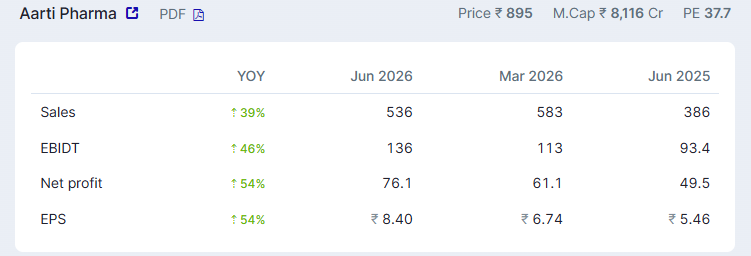
Aarti Pharmalabs is hitting the upper circuit and continuing to move higher today.
The trigger was its Q1 FY27 results, but there is more to the story than just a strong profit number.
So, what exactly went right in Q1?
And more importantly, is this just one exceptionally strong quarter, or is something structurally changing at Aarti Pharmalabs?
Let’s break it down.
Three businesses, three different stories:
Aarti Pharmalabs operates across three key businesses: Xanthine & its derivatives, API & Intermediates, and CDMO-CMO services.
And the mix is quite interesting.
Xanthine and its derivatives account for around 57% of turnover.
The API & Intermediates business contributes around 30%, while CDMO-CMO contributes around 7%.
So today, this is still largely a Xanthine and API story. But that could change over the next few years.
Xanthine is driving the current earnings. API is going through a transition. And CDMO could become the bigger long-term opportunity.
Let’s start with Xanthine.
Xanthine remains the core engine. Around 80% of Xanthine revenue comes from exports, with the remaining 20% coming from the domestic market.
The customer mix is also worth noting:
74% from beverage customers
26% from other customers
The company has historically operated at around 6,000 MT of Xanthine production capacity. Now, that is changing.
The company is expanding capacity towards 9,500 MT, with the additional capacity already commercialized and trial production underway for the final product.
Management expects the new capacity to ramp up over the next few quarters and believes it can reach 80%+ capacity utilisation by FY28.
And this is where the bigger opportunity lies: Management is targeting 20–25% global market share over the next two years.
China remains the dominant player, accounting for roughly 80–90% of global Xanthine production, according to management.
So the opportunity is pretty simple:
More capacity + higher utilisation + better cost absorption = higher absolute gross profit.
But there is a catch: Xanthine prices have already come down.
The company benefited from a significant increase in Xanthine realizations, which helped push gross margins to almost 56% and EBITDA margins to 25.4% in Q1.
These are very strong numbers. However, management has also made it clear that prices are below their peak.
The good news is that they are still higher than pre-war levels. Some structural changes in China could support the pricing environment.
China has removed its export rebate, which management believes has structurally increased Xanthine prices. There has also been tightening of Chinese quotas.
So while China remains the biggest competitor, the supply environment appears to be getting more rational. That could help support margins even as prices normalize.
The real question: can volumes replace pricing?
This is probably the most important question for investors.
Q1 was clearly a strong quarter. But management itself has indicated that the quarter was exceptional and avoided giving a very precise revenue outlook because of the uncertainty around
normalization.
For Xanthine, the broad revenue range discussed was around ₹900–1,100 crore. So, Can the company grow volumes fast enough to compensate for some moderation in pricing?
The capacity expansion gives it a pretty strong lever. Production is moving from around 6,000 MT to 9,500 MT over the next couple of years.
If the company can ramp this capacity while maintaining reasonably healthy pricing, the absolute gross profit can continue to grow even if margins come down from Q1’s unusually high levels.
And that is a much more sustainable way to look at the story.
API is a different story:
The API & Intermediates business contributes around 30% of turnover.
Here, the company is facing some pricing pressure.
Management is developing new molecules where patents are expected to expire over the medium term. But the existing molecules continue to face pricing pressure.
This is why the company has started a special project focused on process intensification and reducing the cost of existing products.
There was also a shutdown during the quarter related to debottlenecking, which impacted sales. The good news is that the debottlenecking is now complete.
Management expects the API business to normalize going forward, with a quarterly revenue run-rate of around ₹170–190 crore.
So the next few quarters should tell us whether the API segment can stabilize and start contributing more consistently to earnings.
But the bigger opportunity may be CDMO:
This is where the story gets more interesting. The CDMO-CMO business currently contributes only around 7% of revenue.
But the pipeline is already quite meaningful. The company is currently working with 22 different customers and has 57 active projects.
1Out of these:
37 projects are already in commercial stages
20 projects are under development
That gives the company a decent base to scale from. And management is quite confident here.
It has guided for 40–50% growth in CDMO-CMO revenue in FY27 and said it remains confident of achieving this.
The long-term ambition is much bigger: ₹1,000 crore of CDMO-CMO revenue.
If that happens, the business mix could look very different from what it does today.
Capacity is being added for CDMO too:
In Q1 FY27, Aarti Pharmalabs completed debottlenecking of its steroid block.
This increased existing steroid capacity by around 33%. The company has also announced ₹149 crore of capex for an additional intermediate manufacturing block, with groundbreaking expected by Q3 FY27.
This is important because CDMO is not a business where you can simply switch on growth overnight.
Aarti already has 57 active projects. The next step is converting more of these projects into commercial revenue.
Our Takeaway:
We think the market is looking at three things at the same time.
First, the existing Xanthine business delivered very strong profitability. Higher realizations pushed gross margins close to 56% and EBITDA margin to 25.4%.
Second, the company is adding significant Xanthine capacity. Production capacity is moving from around 6,000 MT towards 9,500 MT, giving the company a meaningful volume opportunity.
And third, the CDMO business is still small, but the project pipeline, customer base, capacity additions, and 40–50% growth guidance suggest that it could become a much larger contributor
over the next few years.
That combination is what makes the Q1 result interesting.
The way we see it is: A strong current business + significant capacity expansion + a growing CDMO pipeline.
The next few quarters will tell us whether Q1 was just a peak quarter or the beginning of a much stronger earnings cycle.
Disclaimer — This article is for information purposes only and should not be considered investment advice or a recommendation to buy or sell any security. Please conduct your own research or consult a qualified financial advisor before making any investment decision. Reco Wealth is a SEBI-registered Research Analyst.