

Over the last two years, Arman Financial has gone through one of the toughest periods in its history.
Write-offs increased, NPAs rose sharply, collections weakened, and profitability took a hit. But this wasn’t a company-specific problem. Almost the entire microfinance industry went through a similar phase.
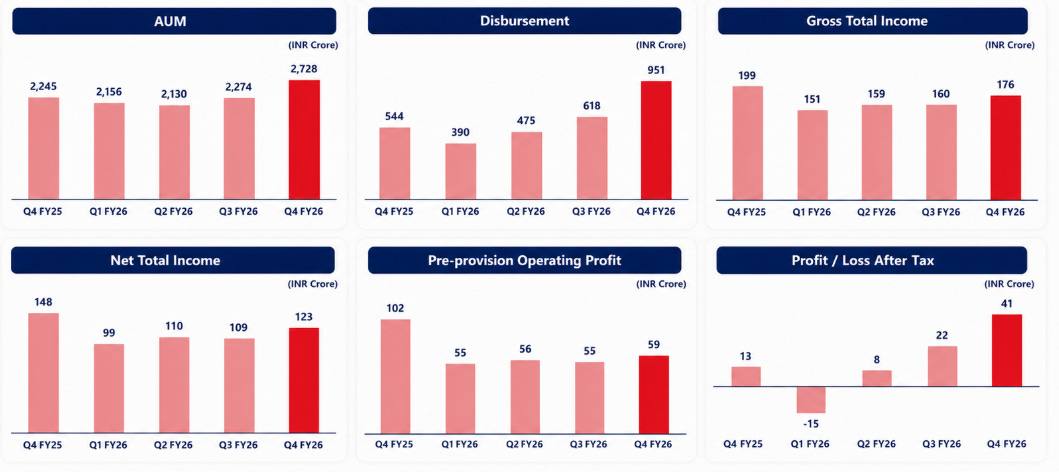
Now, the numbers are starting to look better:
Disbursements are picking up, collections have improved, and the balance sheet looks much healthier than it did a year ago. To understand why this matters, we first need to understand what went wrong with the MFI sector.
Let’s start with the industry:
India is still significantly underpenetrated when it comes to formal credit. Only about 15% of the population borrows through formal financial institutions, compared with nearly 55–60% in developed markets such as the US and the UK. That means millions of individuals and small businesses still depend on informal money lenders for credit.
The MFI industry largely operates using the Joint Liability Group (JLG) model. A small group of borrowers takes individual loans while collectively ensuring everyone repays. Since borrowers usually know each other, peer pressure helps maintain repayment discipline even without collateral. The model worked extremely well for many years. In fact, nearly 79% of the industry’s loan book eventually became JLG-based.
So, What Went Wrong?
The problem wasn’t the model. It was how the model started being used. As lenders chased faster growth, sales teams became increasingly focused on disbursements. Groups were often formed with unrelated borrowers instead of genuine community members. Many borrowers also started taking loans from multiple lenders at the same time.
Some even became part of three or more JLGs, creating excessive leverage. In certain cases, lenders also discovered fictitious or “ghost” borrower groups. Eventually, repayment discipline started breaking down.
Eventually, The Entire Industry Went Through Stress:
Between 2023 and 2024, asset quality deteriorated sharply across the industry. Portfolio-at-Risk (measures the proportion of a loan portfolio that is overdue or in default) above 30 days increased from around 1% to nearly 6.2% at its peak.
Credit costs increased, collections weakened, and profitability came under pressure for almost every MFI. This wasn’t unique to Arman Financial. The entire sector was correcting after a period of excessive lending.
Now, let’s dive deeper into Arman Financial:
Founded in 1992 by Jayendra Patel, Arman Financial generates around 73% of its loan book from microfinance through its subsidiary, Namra Finance. The company has also been gradually diversifying into MSME lending, two-wheeler finance, and loan-against-property loans. Its primary markets include Gujarat, Maharashtra, Rajasthan, and Uttar Pradesh.
FY25 was a difficult year, as MFI Stress started to reflect in its books; Arman reported nearly ₹220 crore of write-offs during FY25. Gross NPA increased to around 4%, while collection efficiency briefly dropped to nearly 24% from its normal level of 97–98%. Eventually, profitability suffered, and investor confidence weakened. But the latest quarter tells a different story.
Early Signs of recovery have started showing in its books. Q4 disbursements grew nearly 70% YoY. Profit also improved significantly on a sequential basis. The operating trends are clearly improving. Collections are stronger. Growth has returned. Credit costs are gradually moderating.
Management Has Also Changed the Lending Process:
One of the key changes has been the shift towards a Business Correspondent (BC) model. Earlier, the same employee was responsible for both loan disbursement and collections. Now, these responsibilities have been separated. This reduces conflicts of interest and encourages better underwriting discipline.
The transition has increased operating costs in the short term, pushing the cost-to-income ratio to around 51%, but management expects this to improve as the model matures.
Also, they have adopted the CGFMU (Credit Guarantee Fund for Micro Units) scheme, which acts like insurance on the loans they disburse. Around 90% of their loan book is covered under the scheme, which provides a credit guarantee for loans extended under the Pradhan Mantri Mudra Yojana (PMMY).
One Number That We Found Interesting:
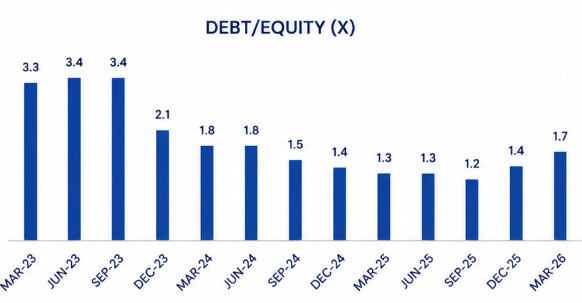
Arman’s Debt-to-Equity ratio has reduced significantly. It has fallen from around 3.4x in FY24 to nearly 1.7x today. For most businesses, lower leverage simply means lower debt. But for a lender, it also means there is room to grow again.
As the company gradually increases leverage, it can disburse more loans, expand its loan book, and improve earnings over the coming quarters, provided asset quality remains under control.
Valuation Still Looks Interesting:
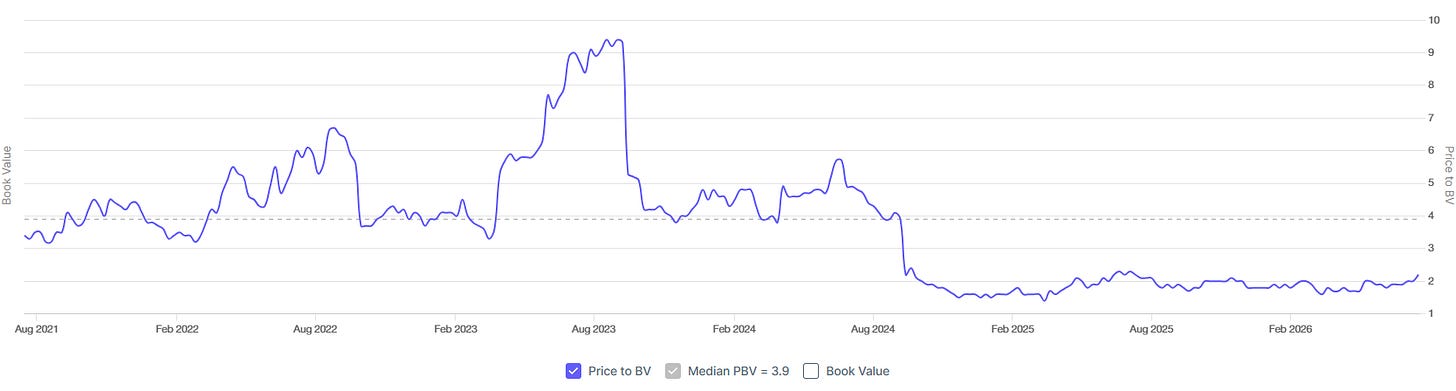
Despite the improving operating performance, the stock continues to trade well below its historical valuation.
Arman currently trades at around 2x Price-to-Book, compared to its historical median of nearly 4x. During strong MFI cycles, the stock has even traded at much higher multiples. If the industry recovery continues and earnings normalise, both earnings growth and valuation re-rating could contribute to shareholder returns.
Our Biggest Takeaway:
The stress that the MFI industry experienced between 2023 and 2024 was real, but it was largely driven by aggressive lending rather than weak structural demand. India’s formal credit penetration still remains low, and the long-term opportunity for microfinance is still intact.
For Arman Financial, the early signs of recovery are already visible. Collections have improved, disbursements are growing again, and the company has enough balance sheet capacity to accelerate growth when the cycle strengthens.
The recovery is still at an early stage, so investors should continue monitoring asset quality closely. But if the current trend continues, Arman Financial appears well placed to benefit from the next phase of growth as the MFI cycle normalises.
Disclaimer — This article is for information purposes only and should not be considered investment advice or a recommendation to buy or sell any security. Please conduct your own research or consult a qualified financial advisor before making any investment decision. Reco Wealth is a SEBI-registered Research Analyst.