
Over the weekend, India’s four largest private banks- ICICI Bank, HDFC Bank, Kotak Mahindra Bank, and Axis Bank- reported their Q1 results.
At first glance, the numbers looked mixed. But if you dig a little deeper, one trend becomes very clear.
Banks are still growing their loan books strongly, but profitability is coming under pressure as interest rates fall and low-cost deposits become harder to attract.
Before we dive into the results, let’s quickly understand two terms that you’ll see repeatedly:
Net Interest Margin (NIM) is the difference between what a bank earns on loans and what it pays on deposits. Simply put, it shows how profitable a bank’s core lending business is. A higher NIM generally means the bank is earning more from every rupee it lends.
Net Interest Income (NII) is the total interest a bank earns minus the interest it pays to depositors and other lenders. It represents the actual income generated from the bank’s lending operations.
In simple words, NIM measures profitability as a percentage, while NII measures the actual amount of profit earned from lending.
Let’s break down what happened by understanding each bank’s results.
ICICI Bank: The Clear Winner This Quarter
If there was one bank that stood out this earnings season, it was ICICI Bank.
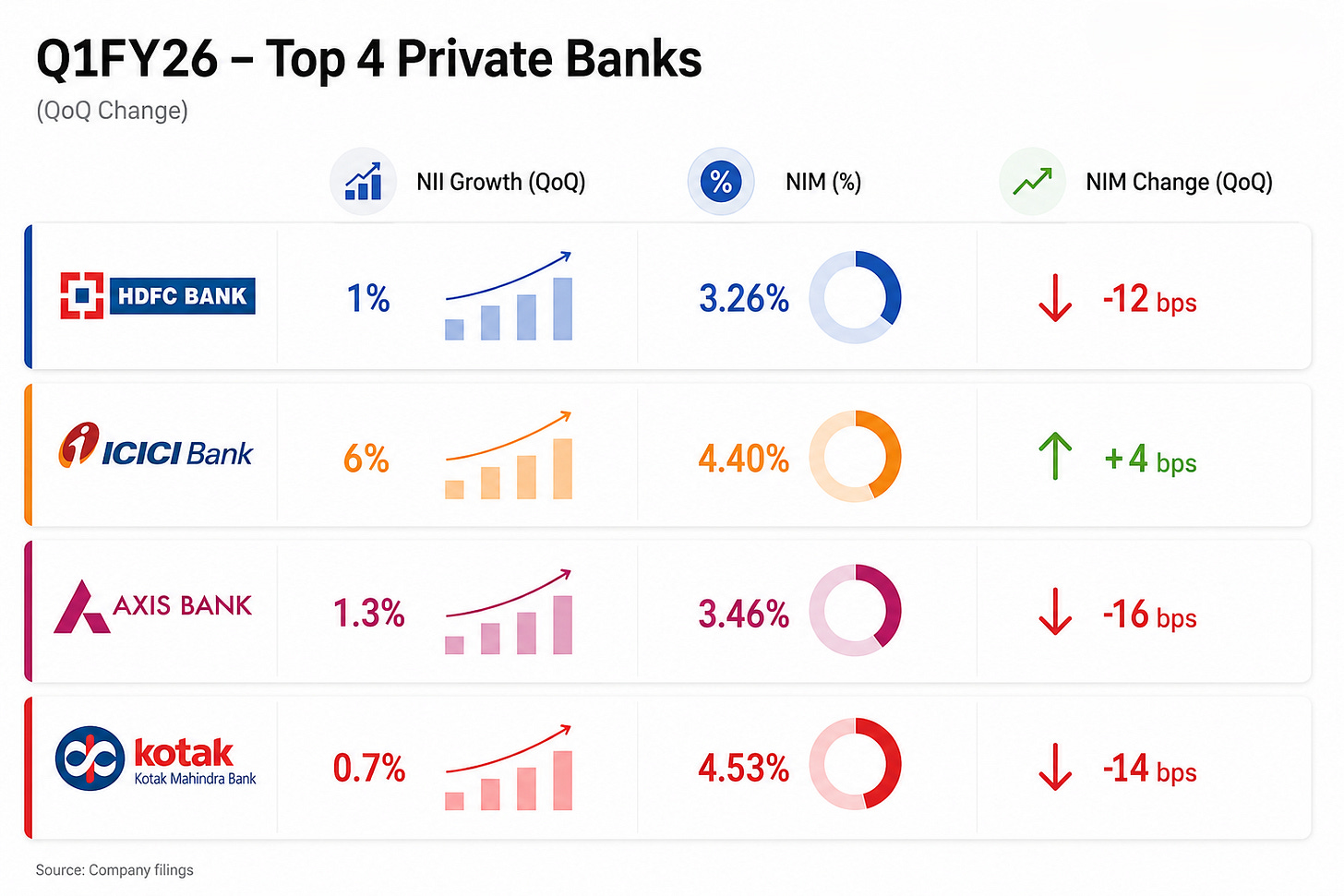
Despite a challenging environment, the bank managed to increase its Net Interest Margin (NIM) by 4 basis points sequentially, which was a positive surprise when most peers reported margin pressure.
Even more impressive was its lending growth.
Advances grew 20% YoY, the fastest among the large private banks, showing that ICICI continues to gain market share without impacting profitability.
Another encouraging sign was fee income.
Processing fees, transaction banking, forex, trade finance, and deposit-linked fees all continued to grow, reducing the bank’s dependence on interest income alone.
Management believes margins should remain broadly stable from here if interest rates remain unchanged.
Our View: ICICI Bank continues to execute well across almost every metric, including loan growth, margins, and fee income.
HDFC Bank: Growth Is Fine, Margins Are The Problem
HDFC Bank delivered another quarter of healthy balance sheet growth, but the biggest disappointment was its margins.
NIM fell 12 basis points QoQ to 3.26%, a sharper decline than the market expected.
Management explained that lower funding costs will take time to reflect in earnings. As expensive borrowings mature and more low-cost CASA deposits are added, margins should gradually improve.
And that’s where the biggest challenge lies.
CASA deposits actually fell 3% sequentially, taking the CASA ratio to around 32%, well below the bank’s long-term target of 38–40%.
The good news is that loan growth remains healthy.
Gross advances grew 13.4% YoY, while deposits also grew 13.3% YoY, supported mainly by term deposits.
On asset quality, there wasn’t much to worry about.
Management also indicated that the upcoming Expected Credit Loss (ECL) transition should have only a minimal impact because existing provisions are already sufficient.
Our view: HDFC Bank’s long-term story remains intact, but rebuilding margins and improving CASA will be the key things investors should watch.
Kotak Mahindra Bank: Stable Business, But Deposits Need Attention
Kotak’s quarter was relatively stable.
Unlike many peers, its core NIM remained almost unchanged at 4.53%, showing resilience despite industry-wide pressure.
Management also clarified that earlier comments about margin pressure were more about the overall banking sector rather than Kotak specifically.
Loan growth remained healthy at 15% YoY, led mainly by corporate and institutional lending. However, retail lending remained relatively soft. The bigger concern came from deposits.
CASA deposits declined 7% sequentially, causing the CASA ratio to fall from 43.3% to 40.3%.
Like other banks, Kotak now faces the challenge of attracting more low-cost deposits.
On the positive side, asset quality remained stable with no major surprises.
Investors are also closely watching the ongoing CEO succession process. Management reiterated that the transition remains on track and is progressing according to regulatory timelines.
Our view: Kotak continues to remain fundamentally strong, but deposit mobilisation and leadership transition will remain key monitorables over the next few quarters.
Axis Bank: Strong Growth Overshadowed By Multiple Concerns
Axis Bank reported strong loan growth, but several factors kept investors cautious.
Advances grew 19% YoY, while deposits increased 18% YoY, allowing the bank to continue gaining market share.
However, profitability remained under pressure.
NIM declined sharply to 3.46%, with management attributing the fall mainly to RBI rate cuts and changes in the loan mix.
As a result, Net Interest Income (NII) grew only 8%, much slower than loan growth.
Retail lending also continued to lose share, falling from 55% to 54% of the loan book, while wholesale lending grew significantly faster.
Another factor weighing on sentiment was management churn.
After recent leadership changes, the bank also announced that its CFO will step down, adding another uncertainty for investors.
The positive side was asset quality, which continued to improve.
Gross and Net NPAs both declined compared to last year, indicating that credit quality remains comfortable.
Our view: Axis Bank continues to grow faster than the industry, but margin pressure and leadership uncertainty remain the biggest concerns.
Our takeaway:
Looking across all four banks, a few common themes clearly emerge.
-Loan growth remains healthy, showing that credit demand in the economy is still strong.
-Margins are under pressure as RBI rate cuts flow through the system.
-CASA deposits have become the biggest battleground, with almost every bank talking about improving low-cost deposit mobilisation.
-Fee income is becoming increasingly important, helping banks reduce dependence on interest income.
-Asset quality remains strong across the sector, with no major deterioration visible.
The biggest difference between the banks this quarter was execution.
One thing is clear: the next few quarters won’t be about who grows loans the fastest. They will be about which bank can protect margins while continuing to attract low-cost deposits.
Disclaimer — This article is for information purposes only and should not be considered investment advice or a recommendation to buy or sell any security. Please conduct your own research or consult a qualified financial advisor before making any investment decision. Reco Wealth is a SEBI-registered Research Analyst.