
When people think about India’s growth story, they usually think about banking, manufacturing, defence, or infrastructure.
Very few think about waste.
But as India’s economy grows, so does something that almost nobody talks about: garbage.
More e-commerce deliveries. More packaged food. More plastic. More electronics. More vehicles.
Every new layer of consumption creates another layer of waste.
Today, over 77% of India’s waste is still dumped in open land, creating serious environmental and public health challenges. At the same time, cities are struggling to keep pace with rising waste generation.
According to Modor Intelligence, the Indian Waste Management Market size was valued at USD 13.58 billion in 2025 and is estimated to grow to reach USD 18.94 billion by 2031, at a CAGR of 5.80% during the forecast period (2026-2031). This is exactly why waste management is no longer just an environmental issue. It is becoming one of India’s largest long-term infrastructure opportunities.
The real story is simple: waste is no longer something to throw away. It is becoming a resource. And once you look at it that way, the industry’s value chain becomes much more interesting.
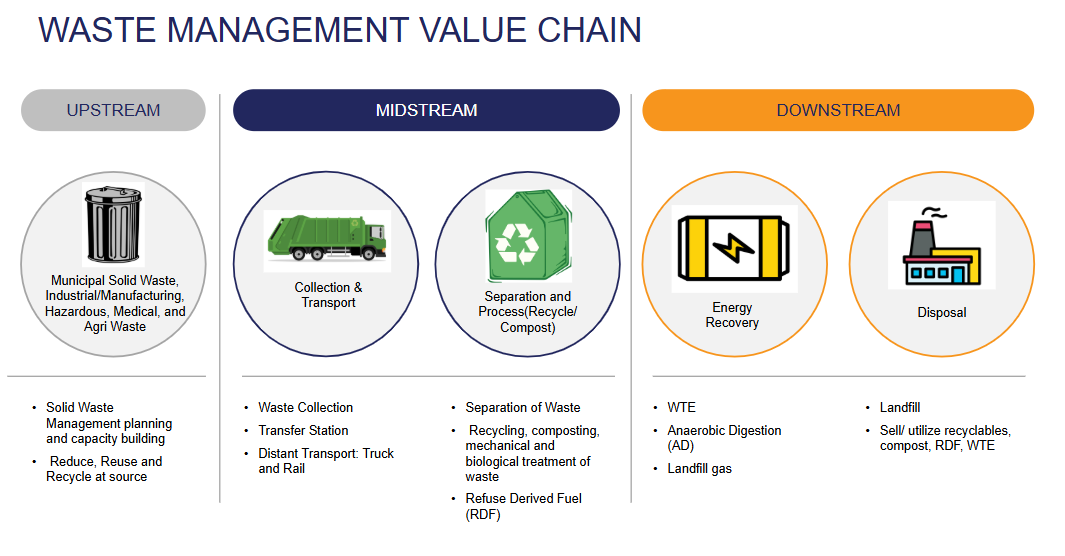
Understanding the Waste Management Value Chain:
Like most industries, value is created in multiple stages. Each stage solves a different problem.
1. Upstream: Where Waste Begins:
The first challenge isn’t recycling. It’s making sure waste actually gets collected.
If households, offices, and industries don’t segregate waste properly and cities cannot transport it efficiently, the entire recycling ecosystem breaks down. This is where collection and transportation companies play a critical role.
Take Antony Waste Handling Cell, for example. The company manages around 90% of Mumbai’s municipal waste through its Kanjurmarg facility. Interestingly, its biggest business isn’t recycling. Collection and transportation contribute nearly 61% of its revenue. Without an efficient collection network, there is no recycling industry.
2. Midstream: Where Waste Becomes Valuable:
Once waste is collected, the real value creation begins.
Waste is transported to processing facilities where it is segregated into plastics, paper, metals, organic waste, glass, and other materials.
Each category then follows a different recycling or processing route. This is where specialised recycling companies operate.
Take Ganesha Ecosphere, one of India’s largest PET recyclers. The company has a recycling and washing capacity of 196,440 MTPA and converts used PET bottles into recycled polyester fibre and other value-added products, reducing dependence on virgin plastic.
Another interesting player is Tinna Rubber & Infrastructure. The company focuses on recycling End-of-Life Tyres (ELTs) and has been operating in this space for over four decades.
Its business is fully integrated from collecting discarded tyres to producing recycled rubber materials, and as of FY25, it had a tyre-crushing capacity of 185,000 MT.
These businesses show how materials that were once considered waste are now becoming valuable industrial inputs.
3. Downstream: Extracting the Final Value:
The final stage is where waste is converted into usable resources.
Depending on the type of waste, it can be transformed into:
Electricity through Waste-to-Energy plants
Biogas through Anaerobic Digestion
Power generated using landfill gas
Only the small portion of waste that cannot be processed is eventually sent to landfills. The objective isn’t just disposal anymore. It’s maximum resource recovery.
The Policy Tailwind Investors Should Know:
One regulation is quietly changing the economics of this entire industry. It’s called Extended Producer Responsibility (EPR). The concept is straightforward.
If a company manufactures plastic packaging, batteries, tyres, or electronic products, it is also responsible for ensuring those products are collected and recycled once they become waste.
The EPR framework also imposes mandatory annual targets for recycling and use of recycled content. This shifts waste management from an informal activity to a structured, organised industry. As compliance requirements become stricter, more recycling capacity, collection networks, and processing infrastructure will be needed. That creates opportunities across the entire value chain.
Our takeaway:
Waste Management isn’t just about solving an environmental problem anymore. It is gradually becoming a core infrastructure theme for India’s next decade of growth.
While the sector is still at a relatively early stage, the companies that build scale, execute well, and create efficient recycling ecosystems could be among the biggest beneficiaries as India’s circular economy continues to develop.
As always, the opportunity lies in identifying businesses with strong execution, sustainable economics, and the ability to grow alongside this structural trend.
Disclaimer — This article is for information purposes only and should not be considered investment advice or a recommendation to buy or sell any security. Please conduct your own research or consult a qualified financial advisor before making any investment decision. Reco Wealth is a SEBI-registered Research Analyst.