

At first glance, SBI Funds Management’s IPO may look like another financial services listing. But if you look beyond the headline, it is one of the biggest ways to participate in India’s long-term wealth story.
Let’s start with the industry.
India’s mutual fund industry has grown rapidly over the last few years, and this trend is far from over. Industry assets are expected to grow at 16-18% CAGR till FY30, after growing at 20.5% CAGR between FY21 and FY26.
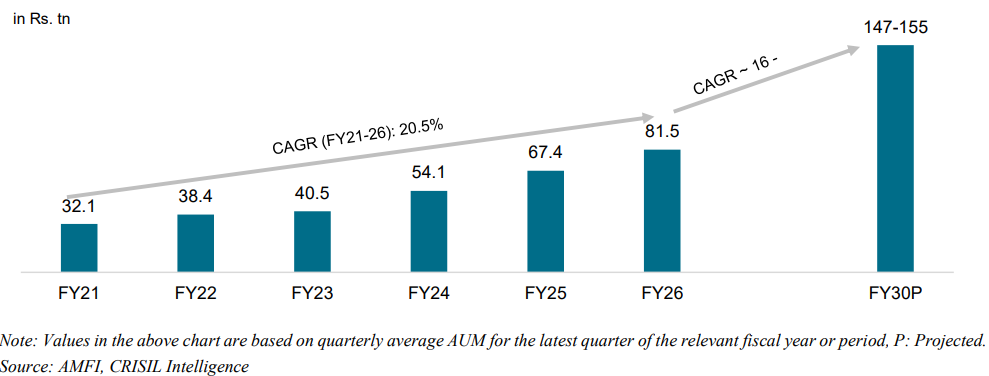
The opportunity is still massive because India remains significantly underpenetrated compared to developed markets. Mutual fund AUM is just 18.5% of India’s GDP, while countries like the US, Canada, and France have AUM-to-GDP ratios above 80%. As household savings continue shifting from physical assets to financial assets, the runway for growth remains long.
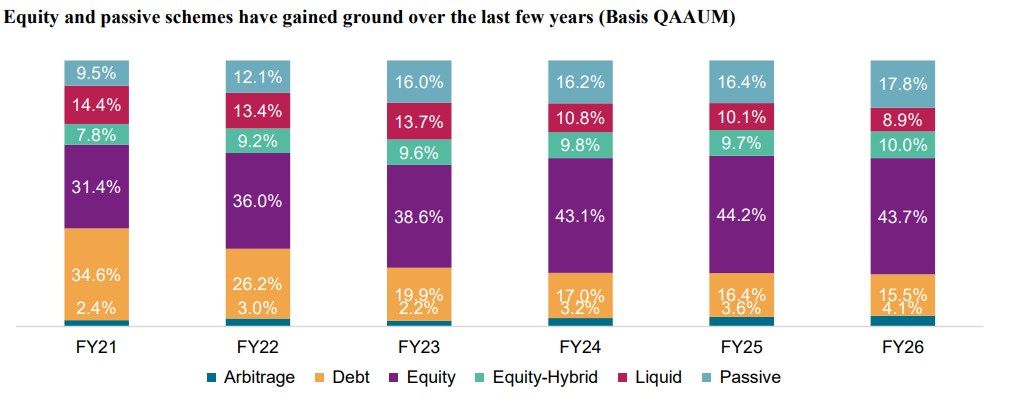
Also, Investor preferences are changing.
Equity mutual funds now account for 43.7% of industry assets, up from 31.4% in FY21, while passive investing continues to gain popularity, with passive products increasing their share from 9.5% to 17.8% over the same period.
Now, let’s dive deeper into SBI Funds Management:
SBI Funds Management is the oldest and largest asset manager in India, managing over ₹12.7 lakh crore of AUM. It is backed by State Bank of India, India’s largest bank, and Amundi Asset Management, Europe’s largest asset manager.
Its biggest competitive advantage is distribution. Nearly 65.2% of its SIP accounts come from B30 cities(smaller cities beyond the Top 30), supported by SBI’s unmatched branch network. While many AMCs are still trying to expand beyond metro cities, SBI already has a deep presence across the country. This gives it access to millions of first-time investors as mutual fund penetration increases.
The company has also built leadership beyond mutual funds.
It is India’s largest PMS player by assets, with a 39.7% market share, and also leads the Specialized Investment Fund (SIF) segment with ₹2,995 crore of AUM. It also manages nearly half of the equity corpus of one of India’s largest statutory provident fund institutions, highlighting the trust it has among institutional investors.
But one interesting point stood out while comparing SBI Funds with listed peers.
Despite managing the largest AUM, its operating margin is relatively lower compared to its peers. The reason is not weaker profitability, but the mix of assets it manages.
SBI has by far the largest passive and ETF book in the industry, with over ₹4 lakh crore of passive assets. Passive funds charge significantly lower fees than actively managed equity funds, which naturally pulls down the company’s blended yield. Its client mix also plays a role.
SBI manages a much larger share of corporate and institutional money than peers like ICICI Prudential AMC and HDFC AMC. Institutional assets usually come at lower fee rates, unlike retail equity SIPs, which generate much higher yields.
In other words, SBI’s business is built on scale rather than higher pricing. Its AUM mix is broader, driven by ETFs, passive funds, and institutional mandates. Compared to its peers, which generate better margins because they have a higher proportion of retail equity assets, SBI has a scale advantage which is difficult to replicate.
However, investors should also understand the key risks:
First, around 43% of its mutual fund assets are concentrated in just five schemes, while the top 10 schemes account for nearly 60% of total assets. If these schemes underperform, mutual fund inflows could slow.
Second, the company depends heavily on its distribution network. The top five distributors account for over 25% of mutual fund assets, so losing any major distributor could affect future growth.
Third, SBI Funds has contingent liabilities of ₹176 crore. If these obligations materialise, they could affect profits and cash flows.
Finally, the company is facing a GST demand of nearly ₹132 crore related to input tax credit claimed on distribution commissions. An adverse ruling could have a financial impact.
The IPO is entirely an Offer for Sale (OFS), meaning the company will not receive any fresh capital.
Our view on this:
The Indian AMC industry is still in the early stages of growth, and SBI Funds Management has built one of the strongest distribution franchises in the country. While its margins appear lower than some listed peers, that is largely because of its leadership in passive funds and institutional mandates rather than any weakness in the business itself.
At around 38x earnings, the valuation appears reasonable for a market leader. As equity participation and SIP penetration continue to rise, SBI Funds Management remains well-positioned to benefit from India’s long-term wealth journey.
Disclaimer — This article is for information purposes only and should not be considered investment advice or a recommendation to buy or sell any security. Please conduct your own research or consult a qualified financial advisor before making any investment decision. Reco Wealth is a SEBI-registered Research Analyst.