
At first glance, TCS’s Q1 results look mixed. Revenue was slightly better than what the market expected, but profit came in lower than estimates. However, if you look beyond the headline numbers, there are a few things worth paying attention to.
Let’s start with revenue.
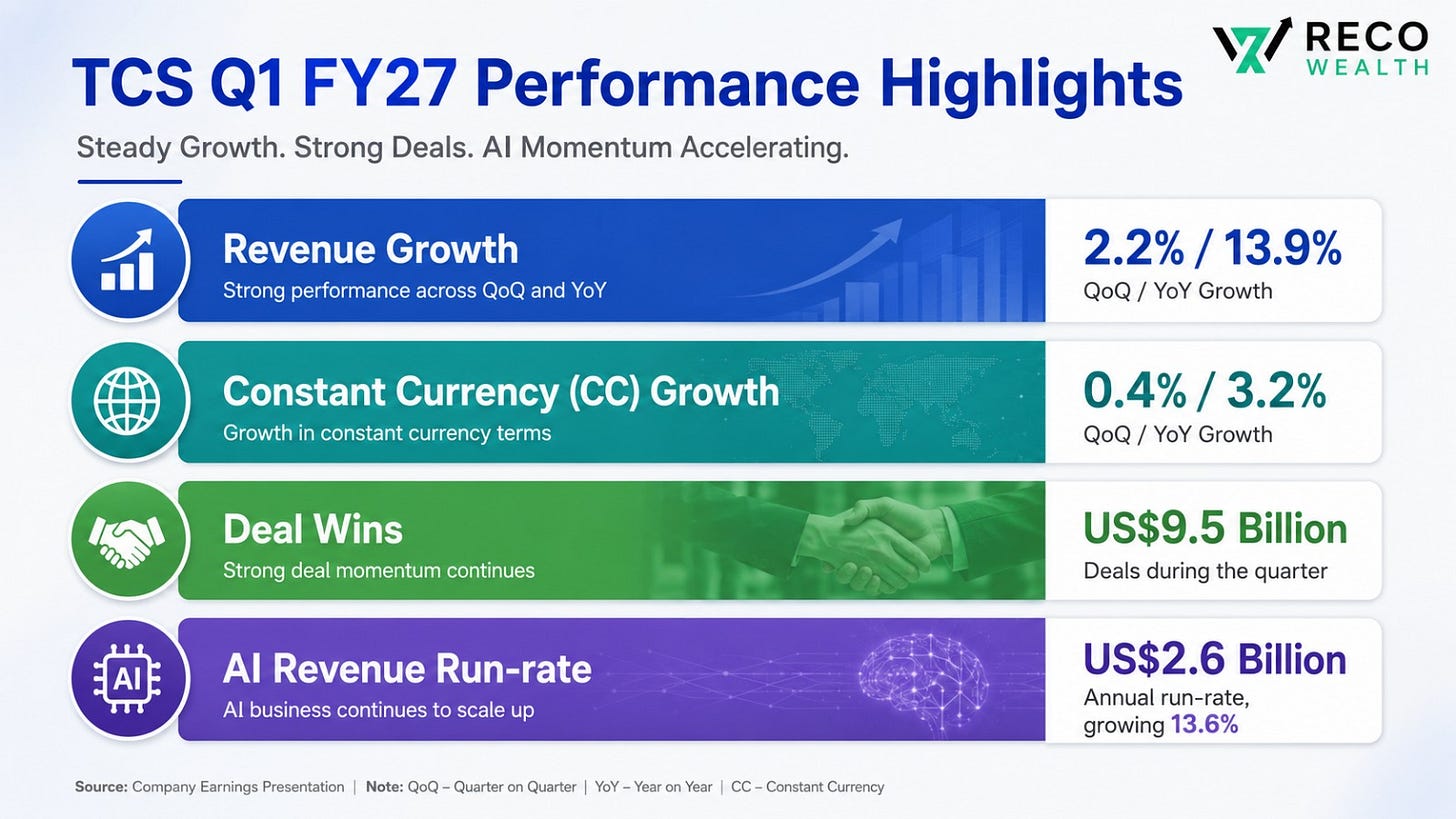
TCS reported 2.2% QoQ and 13.9% YoY revenue growth. But a large part of this growth was due to the Indian Rupee weakening against the US Dollar.
If we remove this currency benefit and look at constant currency (CC) growth, which shows the actual business performance, revenue grew only 0.4% QoQ and 3.2% YoY. That tells us the core business is growing, but the pace is still slow.

On the profit side, PAT came in at ₹13,849 crore, up 1.8% QoQ and 8.5% YoY, but it still missed market expectations as higher employee costs put pressure on margins.
But for us, the most important part wasn’t the earnings. It was what management said about demand and AI.
Despite global uncertainty, TCS won US$9.5 billion worth of deals during the quarter and has now signed six mega deals in the last five quarters. That tells us companies are still spending on technology, especially on large, long-term projects.
Then comes the AI story. AI revenue has reached an annual run-rate of US$2.6 billion, growing 13.6%. Management said demand is strong across AI, software development, IT operations, and business transformation. Some AI projects are still small and short-term, so revenue can be uneven from quarter to quarter, but the overall trend is clearly moving in the right direction.
Major AI-led business transformation deals,
-US$ 800 million mega deal with SKF.
-Multi-million $ strategic partnership agreement with ServiceNow.
-Multi-million $ with Europe-based Fortune Global 50.
Growth in this quarter was mainly driven by BFSI, Technology Services, regional markets, and Products & Platforms. TCS also added over 9,200 employees during the quarter, taking its total workforce to 5,93,798, a sign that it remains confident about future demand.
The adoption of AI is also changing how IT companies make money. Instead of charging only based on time or fixed-price projects, TCS is increasingly signing outcome/output-based contracts, where clients pay for the business results delivered.
Our biggest takeaway is this:
The IT sector is not seeing a full recovery yet, but companies are still willing to spend on areas that improve efficiency, especially AI and digital transformation.
The quarter has looked mixed, but the strong deal wins and growing AI business suggest that the long-term story is still intact. While margins remained under pressure due to targeted investments, the downside for the company looks limited, but investors should expect some volatility as global AI trends continue to evolve.
Disclaimer — This article is for information purposes only and should not be considered investment advice or a recommendation to buy or sell any security. Please conduct your own research or consult a qualified financial advisor before making any investment decision. Reco Wealth is a SEBI-registered Research Analyst.