
When Apple's India sales crossed $10 billion on the back of its expanding retail presence, one stock quietly started moving higher.
It wasn't an Apple supplier.
It wasn't a manufacturer.
It was Redington Limited.
Most investors know Apple. Very few know the business that helps Apple products reach thousands of stores and enterprise customers across multiple countries.
And that's exactly what makes Redington interesting.
So, what does Redington actually do?
At its core, Redington is one of the world's largest technology distributors.
Think of it as the bridge between global technology brands and the businesses or retailers that eventually sell those products.
The company procures products from leading brands, manages warehousing and logistics, distributes them through an extensive dealer network, and also provides after-sales support and supply chain solutions.
But this is no small operation. Today, Redington has:
Presence across 32 countries serving 40 markets
70,000+ channel partners
163 warehouses
62 sales offices
Partnerships with 440+ global brands
Around 5,100 employees
In fact, Redington has grown into a $13.5 billion+ revenue business and is among the Top 10 IT distribution companies globally, while compounding at a strong double-digit CAGR for nearly two decades.
Not bad for a company that rarely makes headlines. Its business is much larger than just smartphones. Most people associate Redington with mobile phone distribution. But that's only one part of the story. Its portfolio spans almost every major technology category.
Endpoint Solutions: PCs, printers and consumables
Technology Solutions: Servers, storage, networking, cybersecurity and enterprise software
Mobility Solutions: Smartphones and feature phones
Cloud Solutions: Cloud resale and managed services
Renewable Energy: Solar panels and inverters
Supply Chain Solutions: Warehousing, logistics and transportation through ProConnect
Other Businesses: IT services, fintech and shared services
This diversification is one of the reasons why the company has continued to scale over the years.
Why did Apple's news move Redington?
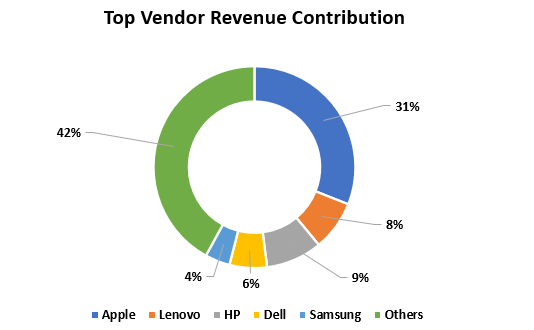
The answer becomes obvious once you look at where Redington earns its money.
As of Q4 FY26:
Singapore, India & South Asia (SISA): 60% of revenue
Rest of the World: 40%
India remains its biggest growth engine.
So when Apple continues expanding aggressively in India, the companies sitting inside that ecosystem naturally attract investor attention. Redington is one of them.
Q1 FY27 was a strong quarter:
The numbers were impressive.
Revenue: ₹34,966 crore (+34% YoY)
EBITDA: ₹751 crore (+67% YoY)
PAT: ₹486 crore (+77% YoY)
What's encouraging is that profits grew much faster than revenue. Management attributed this to strong operating leverage, where expenses increased at a much slower pace than sales.
That's always a positive sign because it shows scale is beginning to improve profitability.
The AI opportunity is becoming real:
One of the most interesting takeaways from the earnings call was about AI.
Management highlighted that AI PCs already account for 36% of commercial PC revenues in India (defined as devices delivering more than 40 TOPS).
Even more importantly, they said the opportunity pipeline runs into multiple thousands of crores, and they don't expect AI hardware demand to slow for the next four to six quarters.
As enterprises upgrade PCs, servers and data centres for AI workloads, distributors like Redington stand to benefit alongside the hardware manufacturers.
Sometimes the biggest winners are not the companies building AI, but the companies enabling everyone else to buy it.
Premium smartphones continue to support growth:
Another interesting trend is India's shift toward premium devices. Overall smartphone growth remains modest.
But management pointed out that the premium segment has grown nearly eight times faster.
That obviously benefits brands like Apple. Management did caution that future price increases could eventually slow this trend, but they still expect momentum to continue in the near term.
Not everything is going perfectly:
Like every business, Redington has its challenges. Its Turkey subsidiary, Arena, continues to be a drag. The business reported a Q1 loss of ₹64 crore, driven by:
-Lower revenues after exiting certain businesses
-Margin pressure in hardware
-High inflation increasing operating costs
-An increasingly competitive market
The good news is that management has already reduced debt significantly and is evaluating strategic alternatives while continuing efforts to revive the business. Losses may continue for some time, but the company is actively de-risking the operation.
What could drive the next phase of growth?
This is where the story becomes even more interesting.
1. Software is becoming a much bigger business:
Redington wants to double its Software Solutions Group to nearly $5 billion by FY29. Instead of being just a distributor, it is gradually positioning itself as a technology solutions partner.
The focus areas include: Cloud migration, Cybersecurity, DevOps, FinOps, and Professional services. These businesses typically generate better margins and more recurring revenue than traditional hardware distribution.
2. More predictable revenue:
Management wants to increase subscription and renewal-based revenue from 63.5% today to around 72% by FY28. That's important because recurring revenue generally makes earnings more stable and predictable.
3. AI ecosystem play:
Rather than betting on one AI vendor, Redington wants to become an ecosystem orchestrator across hardware, software and cloud platforms. As AI deployments become more complex, customers increasingly need partners who can integrate products from multiple vendors. That plays directly into Redington's strengths.
4. Acquisitions could accelerate growth:
Management is also looking at acquisitions in cloud, cybersecurity and professional services to strengthen capabilities and scale faster.
5. GCC could become another growth driver:
After a temporary slowdown due to project reprioritisation under Vision 2030, management expects digital infrastructure and data centre spending in Saudi Arabia to pick up again, supporting another phase of double-digit growth.
Our Takeaway:
Redington is one of those businesses hiding in plain sight. It isn't flashy. It doesn't manufacture the next breakthrough technology.
Instead, it sits quietly in the middle of the technology ecosystem, helping hundreds of global brands reach customers across multiple markets.
With Apple's growing presence in India, AI-driven hardware upgrades, expanding cloud adoption, and a deliberate shift towards higher-margin software and recurring revenue, the company seems to be positioning itself for its next phase of growth.
Sometimes the most interesting businesses aren't the ones creating the products everyone talks about. They're the ones quietly making sure those products reach millions of customers. Redington feels like one of those businesses that deserves a closer look.
Disclaimer — This article is for information purposes only and should not be considered investment advice or a recommendation to buy or sell any security. Please conduct your own research or consult a qualified financial advisor before making any investment decision. Reco Wealth is a SEBI-registered Research Analyst.