
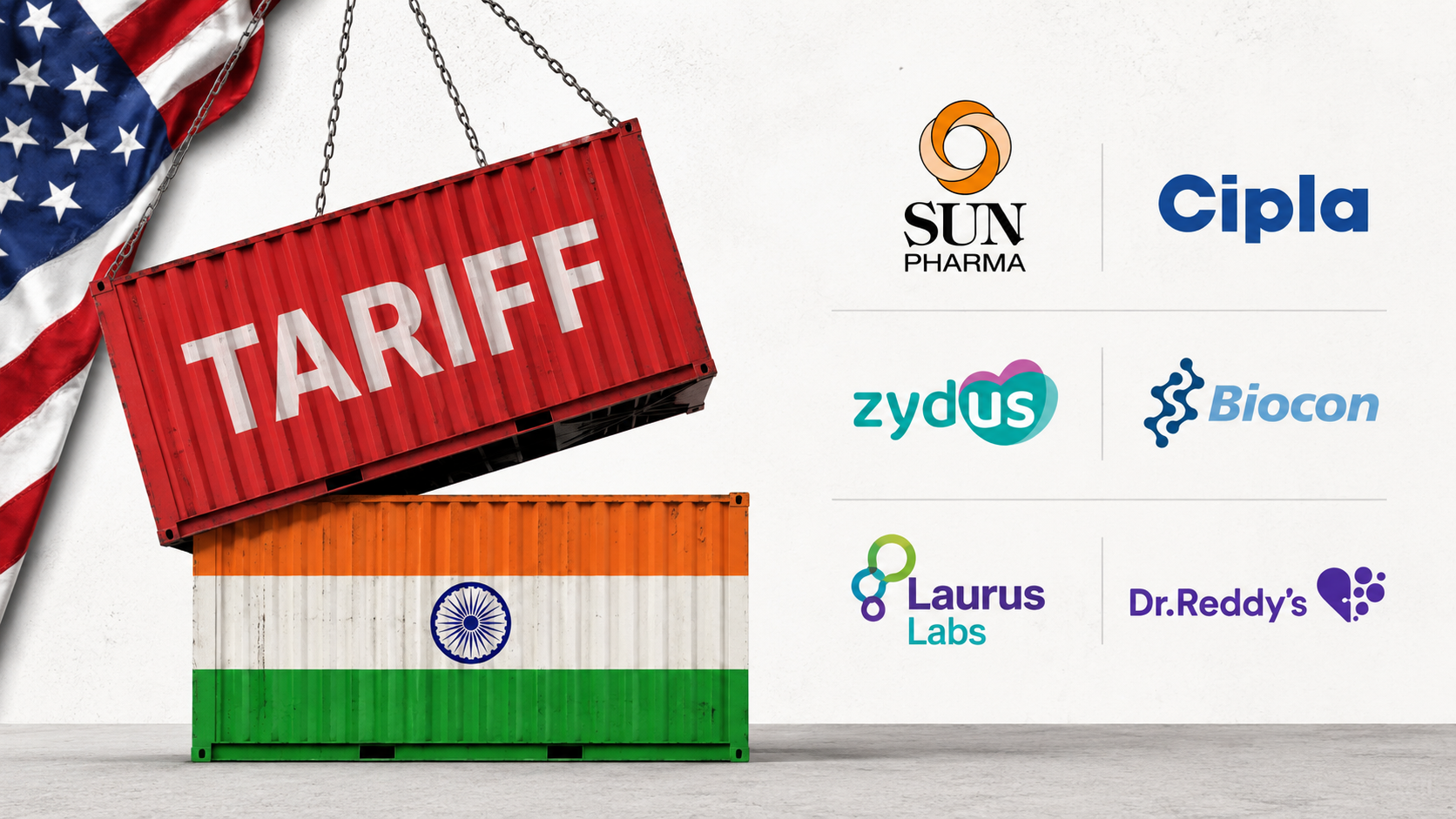
Today, most pharma stocks ended in the red after Donald Trump announced a new tariff plan for imported generic medicines into the US.
The US is the biggest export market for Indian pharma companies, so any policy change naturally makes investors nervous.
But when we looked beyond the headlines, the actual picture seemed a lot more balanced.
So, what exactly was announced?
Trump said that imported generic drugs into the US will continue to have 0% tariff for the first two years (from August 1, 2026). After that, tariffs will increase to 100% in the third year and 200% thereafter.
On paper, that sounds like a huge negative for Indian pharma. After all, India is often called the "Pharmacy of the World." Around 35% of India's pharmaceutical exports go to the US, and Indian companies account for nearly 40% of generic medicines used in the US by volume.
So yes, this is something investors should pay attention to. But here's where we think the market is looking only at the headline. The impact isn't immediate. The first thing to understand is the timeline. There is no tariff for the first two years. The higher tariffs only begin in 2028, which means the financial impact, if any, is likely to reflect only from 2029. So while today's market reaction was immediate, the business impact certainly won't be.
Indian pharma isn't entirely dependent on exports anymore.
Over the last decade, Indian pharmaceutical companies have steadily expanded their presence in the US.
Take Sun Pharma, for example. It already has four manufacturing plants in the US and recently strengthened its presence further through the Organon acquisition.
Similarly, Cipla has five manufacturing facilities in the US, while Biocon(also acquired Mylan, a US-based biosimilar firm) and Zydus Lifesciences also have manufacturing operations there.
This isn't something companies started doing yesterday. They've been investing in the US market for years through acquisitions, partnerships and local manufacturing.
So if tariffs eventually become a challenge, many companies already have the infrastructure to increase local production instead of relying entirely on exports from India.
And there's one more thing many investors seem to be missing.
The announcement is specifically about imported generic medicines.
It doesn't directly impact companies operating in the CDMO (Contract Development & Manufacturing Organisation) or CRO (Contract Research Organisation) space.
These companies don't manufacture generic medicines for export. Instead, they work with global innovator pharmaceutical companies, helping them develop, manufacture and commercialise drugs.
That's a completely different business model. Which means the tariff risk for many CDMO and CRO players remains significantly lower than the market reaction suggests.
Only companies that are heavily dependent on exporting generic medicines from India could see pressure on margins if these tariffs are eventually implemented.
But again, they have time. They can expand manufacturing in the US through partnerships, optimise supply chains, improve product mix, or even pass on part of the higher costs to customers where possible.
Our takeaway:
The market has reacted quickly, but the actual business impact is likely to play out much more gradually.
Yes, companies with high exposure to US generic exports will need to adapt. That's something worth tracking over the next few years.
But we don't think this changes the outlook for the entire pharma sector overnight. In fact, companies with an existing US manufacturing footprint are already in a stronger position. And for CDMO and CRO companies, the risk from this announcement appears much lower because their business isn't centered around exporting generic medicines.
Overall, we think the market is reacting much faster than the actual fundamentals. The companies most exposed to US generic exports may face some long-term challenges, but the impact is neither immediate nor uniform across the sector.
Disclaimer — This article is for information purposes only and should not be considered investment advice or a recommendation to buy or sell any security. Please conduct your own research or consult a qualified financial advisor before making any investment decision. Reco Wealth is a SEBI-registered Research Analyst.